Pomona Adopts Permanent Rent Stabilization Ordinance

This bulletin was sent to me by the Brennan Law Firm.

On November 17, the Pomona City Council voted 5–1—with one member absent—to approve a new permanent rent stabilization ordinance. Council Member Debra Martin cast the lone dissenting vote, arguing that the City should focus on stronger code enforcement rather than imposing permanent rent controls. The new ordinance replaces the two existing urgency ordinances and will take effect January 1, 2026.

The ordinance includes one positive change: it increases the fixed annual allowable rent increase from 4% to 5%. However, the cap remains untethered to the Consumer Price Index (CPI). As a result, during periods of inflation above 5%, housing providers will be unable to keep pace with rising operating costs. This puts many small, independent owners at risk of financial failure—ultimately leading to property sales for demolition and redevelopment into high-end, for-sale units, displacing existing renters. The City Council continues to overlook this substantial and predictable flaw.

Another significant problem is that the ordinance permanently adopts the extraordinarily high and impractical relocation fees first introduced under the urgency ordinances. AAGLA repeatedly raised concerns about these excessive fees—often as the only organization representing rental housing providers at Council meetings. When these fees were originally approved in 2022 by a different Council, Mayor Tim Sandoval himself acknowledged they were “very high,” and city staff was expected to return with a cost study to recalibrate them.

That study was never completed, and no adjustments have ever been made. The relocation fees were initially based on Los Angeles County rents, which were already 34% higher than Pomona’s. Today, the calculation relies on City of Los Angeles rents, which are now 37% higher than Pomona’s. Despite this widening disparity, the current Council declined to correct the issue and instead incorporated these unrealistic fees into the new permanent ordinance. Vice Mayor Steve Lustro defended the decision by pointing to the ordinance’s sunset date of December 31, 2026—cold comfort for small property owners who have already been unable to make major system repairs for more than three years and now face at least one more year of delays.

Major system repairs—electrical, mechanical, foundation, plumbing, and hazardous-materials remediation—cannot be safely completed with tenants in place and typically require 30 days or more. These are not cosmetic upgrades; they are essential for safe, habitable housing. Under the current relocation fee structure, many small owners simply cannot afford to relocate tenants temporarily. This leaves them with two options: sell their property “as is” for demolition, forcing all tenants to relocate, or continue deferring critical repairs, leaving renters in deteriorating conditions.

In both scenarios, renters ultimately suffer. The City is effectively preventing responsible housing providers from completing necessary building repairs—precisely the opposite of what good housing policy should encourage. There is still hope that the Council will eventually revisit the issue and adopt fair, realistic relocation fees based on Pomona’s actual rental market rather than that of much higher-cost cities.

Even more concerning, Mayor Sandoval has expressed interest in reviving the proposal for an expensive and unnecessary rental registry, despite the City’s severe budget challenges. No evidence has been presented showing that local housing providers are violating existing rent stabilization rules. Instead, the push for a registry appears driven by demands from Pomona United for Stable Housing (PUSH) and external tenant-advocacy blueprints, rather than local data or demonstrated need.

As always, we will continue to keep our members informed should a rental registry or other harmful policy proposals resurface on a future Council agenda.

This article is for informational purposes only. If you have questions regarding your property, leasing issues, or the legal requirements described above, please consult an attorney.

Download And Read The Ordinance
L.A. City Enacts Significant Cuts to Allowable Rent Increases

This bulletin was sent to me by the Brennan Law Firm.

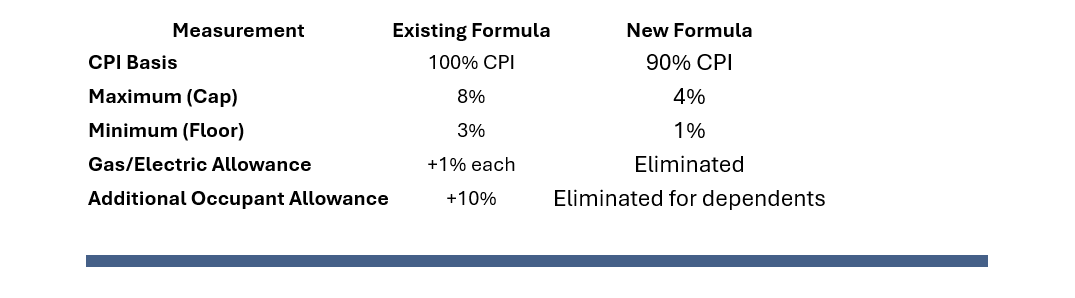
On Wednesday, November 12, the Los Angeles City Council voted 10–2 to significantly revise the Rent Stabilization Ordinance (RSO), adopting a far more restrictive formula for allowable rent increases. The new methodology makes several substantial cuts:

Key Changes to the RSO Rent Increase Formula

  • CPI percentage reduced from 100% to 90%
  • Maximum annual increase (“ceiling”) lowered from 8% to 4%
  • Minimum increase (“floor”) dropped from 3% to 1%
  • Extra 1% increases for gas and/or electricity in master-metered buildings—roughly 20% of all RSO units—eliminated
  • Additional 10% increase for dependent occupants on a lease removed

The updated formula is projected to take effect February 1, 2026, pending final ordinance language from the City Attorney. Given the contentious nature of the meeting and the limited 30-minute total public comment period, further adjustments appear unlikely.


How Did This Happen? A DSA-Led Shift

The push for changes originated with Council Member Nithya Raman, Chair of the Housing and Homelessness Committee. Raman’s initial proposal was even more aggressive—reducing increases to 60% of CPI, capping them at 3%, and eliminating the floor entirely. Council Members Ysabel Jurado (a Democratic Socialists of America member) and Heather Hutt backed the motion.

During the meeting, several amendments were introduced:

Amendments That Failed

Amendment 47E – Soto-Martinez Proposal
Council Member Hugo Soto-Martinez (DSA, RSO renter, and 2026 candidate for re-election) sought to revise the formula to 75% CPI, with a 3% cap and no floor. The amendment was supported by Council Members Hernandez (DSA), Raman, Jurado, Hutt, and McOsker.
It failed with only six votes.

Hernandez Amendment
Council Member Hernandez proposed eliminating the shelter component of CPI—representing 36% of the index and directly related to housing.
Only Hernandez, Hutt, Jurado, Raman, and Soto-Martinez voted in favor, so
the amendment failed.

Amendments That Passed

Amendment 47D – Harris-Dawson Formula
Council President Marqueece Harris-Dawson proposed adjusting the base calculation to 90% of CPI.
Passed with four “no” votes: Hernandez, Hutt, Jurado, and Soto-Martinez.

Amendment 47B – Yaroslavsky, Rodriguez, McOsker
This amendment reduced the ceiling to 4% and the floor to 1%, which ultimately became the core of the final policy.
Only Soto-Martinez voted against it.

Amendment 47A – John Lee
Council Member John Lee proposed an additional 1% increase for small owners (10 or fewer units), similar to the County’s RSO structure.
However, he withdrew the amendment without discussion, leaving small property owners without relief—despite LAHD’s testimony that small owners are being pushed out of the market and forced to sell to large corporate buyers.

Amendment 47C – Harris-Dawson, Yaroslavsky, Raman
This amendment directed LAHD to study requiring entire replacement buildings—not just one-for-one replacement units—to fall under RSO rules whenever an existing RSO building is demolished.
The amendment passed unanimously and is expected to further depress already weakened RSO property values, narrowing the pool of buyers to developers intending to build for-sale luxury housing, townhomes, condominiums, or multi-ADU configurations.


Summary of Changes to the RSO Formula

This article is for informational purposes only. If you have any questions regarding your property or specific tenancies and the requirements of any local law changes described herein, please consult with an attorney

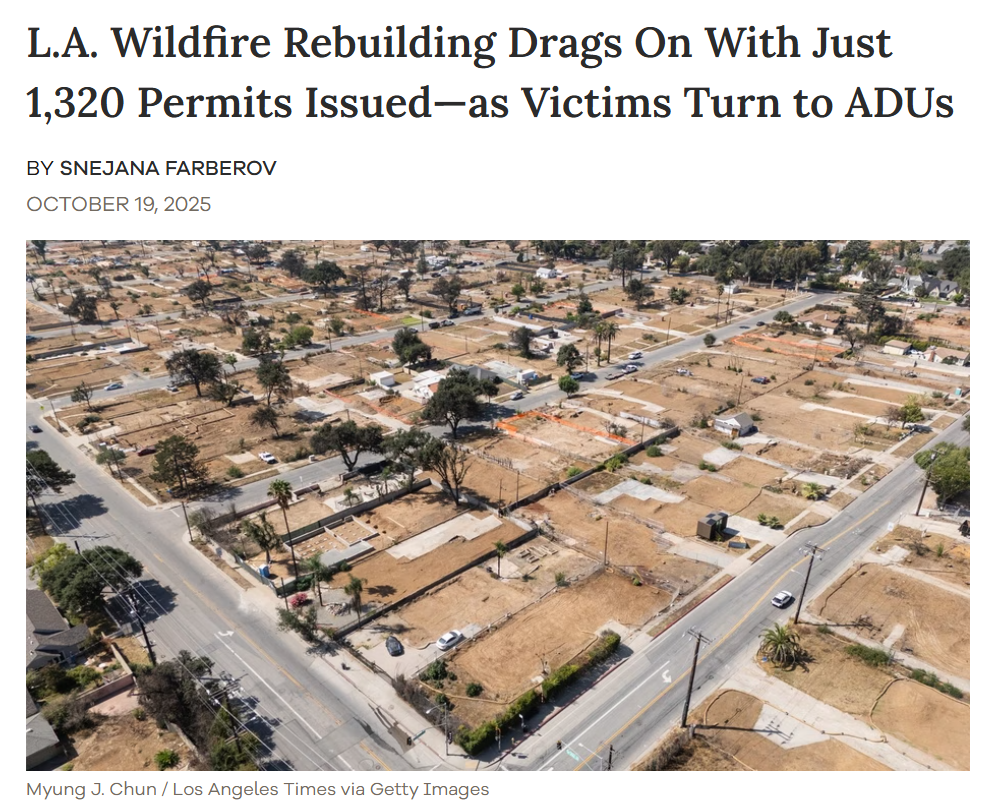
L.A. Wildfire Rebuilding Drags On With Just 1,320 Permits Issued—as Victims Turn to ADUs

The January 2025 fires killed at least 30 people and damaged or destroyed more than 11,000 homes in the star-studded enclave of Pacific Palisades and the community of Altadena

As of Wednesday, the Los Angeles Department of Building and Safety (LADBS) has received a little over 1,800 building permit applications related to post-fire recovery in the section of the Palisades fire zone that falls within L.A. city limits—and approved 758 of them, an agency spokesperson tells Realtor.com®.

READ FULL ARTICLE HERE

Urge Your Legislator To OPPOSE AB 1157!

My letter to the State Legislature:

Dear Assemblymembers,

Time is short so I will be brief.

Areas like Los Angeles and San Francisco have had established Rent Stabilization Ordinances for decades. Those rent control initiatives were meant to keep rent affordable and to reduce homelessness. Decades later, these areas are known for the highest rental rates and highest rates of homelessness in the country.

Facts are facts: rent control does the opposite of what it intends to do. It hurts housing providers. It hurts renters.

AB 1157, however well meaning it may be, will only contribute to the State’s housing problems not aid them.

I urge all of you to strongly OPPOSE AB 1157.

Thank you for your attention.

-Andres Segovia

Get informed and find resources to contact the assembly in the video description here:

All resources are available here:

Los Angeles Keeps Punishing Homeowners

Reacting to the new JCO registration requirements in Los Angeles as presented by Dennis Block, Esquire of The Law Firm of Dennis Block and Associates.

Webinar link: https://www.youtube.com/watch?v=y8uX45ghPQk https://theandressegovia.start.page/ #theandressegovia #losangeles #rentcontrol

Landlord-Tenant Radio: Accessing a Tenant’s Unit

Accessing a Tenant’s Unit
Topics Discussed:
1. Accessing your tenant’s unit
2. Deducting late fees from a security deposit
3. Accessing a unit when only a child is home
4. Lodger
5. Seller fails to vacate after the close of escrow
6. Owner occupancy
7. Who can enter a unit to make repairs
8. Raising rents on a single-family residence
9. Separate parking agreements
10. Renter’s insurance
11. Conflicting dates in a rent increase notice
12. Change of ownership notice
13. Unauthorized occupant
14. Unsealing a court judgment
15. Tenant interfering with workmen
16. Insurance cancelled
17. Repairs should be completed immediately
18. Unsure if a security deposit exists
19. Periodic inspections
via YouTube